When dental problems surface, many patients focus on fixing the immediate issue and moving on. A cracked tooth gets a crown. A cavity gets filled. Gum soreness gets noted and ignored. This approach may seem practical in the short term, but it rarely holds up financially or clinically over time. Addressing dental needs in isolation, without a coordinated plan, tends to generate a cycle of repeat procedures, escalating costs, and compounding damage. The math simply does not work in your favor.
There is a better way to think about dental care, and it starts with understanding the difference between reactive treatment and a comprehensive approach. At Complete Dentistry in Trophy Club, Texas, the philosophy has always been total oral health: addressing the full picture of what a patient needs, educating them on why, and building a plan they can actually follow through on. Before choosing a treatment path, it pays to weigh the real cost difference between these two approaches.
Why Patchwork Treatment Costs More Over Time
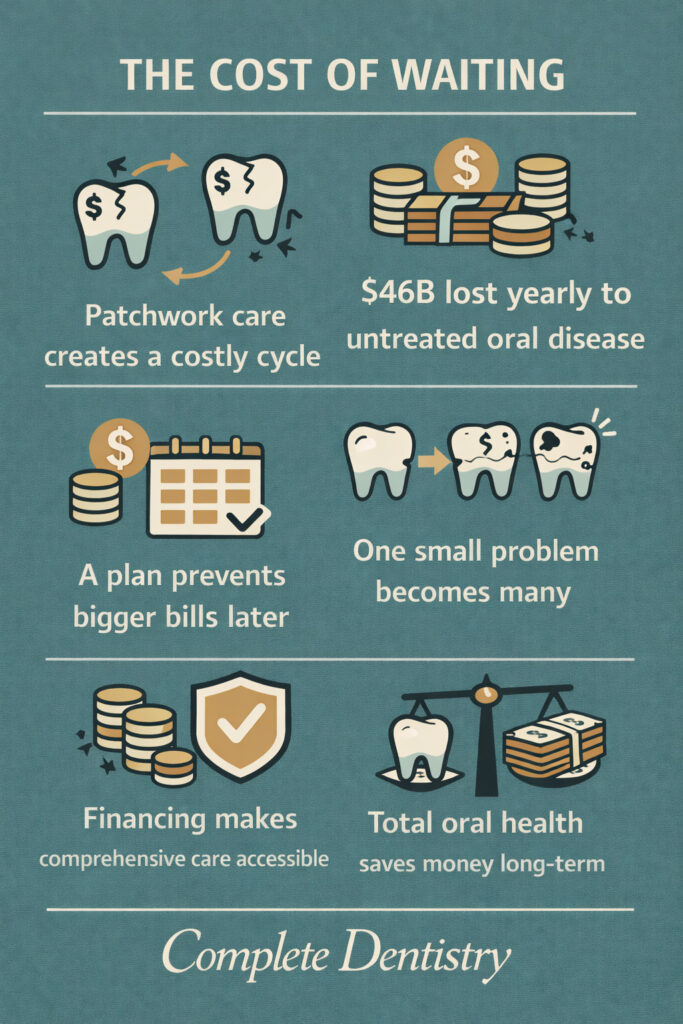
The appeal of patchwork treatment is understandable. Handling one problem at a time can feel more manageable, both emotionally and financially. The problem is that dental conditions rarely stay contained. A small cavity left to progress becomes a root canal. Untreated gum disease leads to bone loss, and bone loss leads to tooth loss. According to the CDC, untreated oral disease costs nearly $46 billion annually in lost productivity across the United States, which reflects just how expensive deferred care becomes at scale.
On an individual level, the pattern is just as costly. A tooth treated with a filling when a crown is needed will often fail and require extraction. An extraction without tooth replacement starts a domino effect: neighboring teeth shift, bite alignment changes, and bone density decreases. What could have been a single well-planned restorative treatment becomes a multi-step, multi-year, much more expensive process. Each individual fix looks small on its own, but the cumulative total tells a different story.
What Comprehensive Care Actually Means
Comprehensive dental care does not mean doing everything at once. It means starting with a thorough evaluation, understanding the full state of your oral health, and building a prioritized treatment plan that reflects your goals, your budget, and realistic timelines. A dentist practicing comprehensive care will identify not just what needs attention today but also what is at risk over the next six months or two years, and help you plan accordingly.
This approach catches problems early, which is where the financial advantage becomes most obvious. A cavity identified duing a routine cleaning and treated promptly costs a fraction of what the same tooth costs once decay reaches the nerve. Early-stage gum disease managed with consistent care costs far less than the periodontal surgery and potential implants that come from years of neglect. Comprehensive dentistry is, at its core, a long-term cost reduction strategy.
The Real Comparison: What You Pay Now vs. What You Pay Later
Consider two patients with similar oral health starting points. The first patient addresses problems individually as they arise, skips cleanings some years, and avoids larger treatment conversations because the upfront cost feels intimidating. Over a decade, this patient handles multiple emergency visits, repeated fillings on the same teeth, an extraction, and eventually an implant to replace the lost tooth.
The second patient commits to a comprehensive plan, attends regular hygiene visits, and follows through on a treatment sequence recommended by their dentist. Their total out-of-pocket spending over the same period is lower, and their oral health outcomes are significantly better.
The numbers behind this comparison are not hypothetical. Research consistently shows that preventive and early-intervention care delivers a strong return compared to the cost of advanced restorative procedures. A tooth saved with a crown costs far less than the extraction, bone grafting, and implant sequence that follows its loss. The difference is planning versus reacting.
How Financing Changes the Equation
One reason patients default to patchwork treatment is the perception that comprehensive care requires a large upfront commitment. In reality, modern financing options make it possible to address more of your needs at once without paying everything out of pocket on day one. At Complete Dentistry, we work with patients to make care accessible through flexible financing and insurance options, including CareCredit, Proceed, and Sunbit and our in-house True Blue Membership Plan.
When you spread the cost of comprehensive treatment over time, the monthly figures become far more manageable than the sticker shock of one large estimate. More importantly, acting on a full plan now prevents the much larger costs of inaction. Financing is not just a convenience feature; for many patients, it is what makes the smarter financial choice actually accessible.
Choose Comprehensive Care at Complete Dentistry
Dr. David Crumpton has spent over 28 years building a practice in Trophy Club around the idea that patients deserve to know exactly what they need and why before any work begins. His approach has always been to show you the full picture, go over costs and options before proceeding, and treat your care the way he would want his own handled. As a CEREC-certified trainer and Invisalign Gold Provider, Dr. Crumpton brings advanced clinical knowledge to every evaluation, supported by tools like Overjet AI diagnostics for more accurate assessments.
If you have been managing dental problems one at a time and wondering why the bills keep coming, a comprehensive evaluation may be the most financially sound step you can take. We welcome patients from Trophy Club, Westlake, Roanoke, and the surrounding North Texas area for a thorough consultation and honest treatment conversation. Contact us to request your appointment today.